

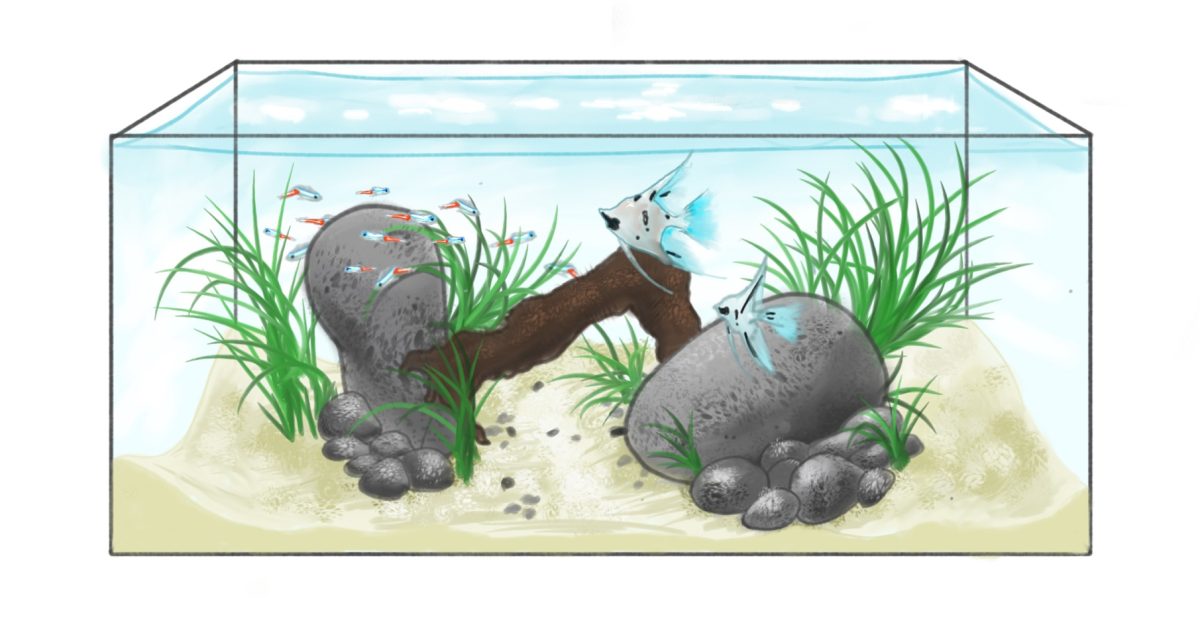
The lost art of aquatic gardening, also known as aquascaping, is making a surprising comeback. It grew from an esoteric hobby to a mainstream event with the help of social media platforms and has captured the interest and creativity of Sage Hill students.
In a chaotic and stressful world, aquascaping provides a calm and routine respite.
“I love doing it most at night since [aqua]scaping is a way for me to wind down,” freshman Violet Lee explains. Indeed, most gardening activities have been proven to calm the mind and reduce stress, as they promote mindfulness and awareness. Just like any land-based garden, aquascaping requires being at peace with a little dirt beneath the fingernails.
“To have a nice scape requires time for plants to grow out and fish to settle in,” Lee adds. Caring for plants, fish and algae requires both long-term patience and commitment. “[It is] important not to judge a scape by how it initially looks,” Lee continues. The most stable tanks often had very rocky (or sandy, perhaps) beginnings. Ammonia spikes, scores of dead fish and rotten plants and algae blooms often provide a strong biological foundation for future scapes. “One of my problems has been algae and I’m still struggling with it,” Lee explains, “it has been difficult to remove.” Yet, as with the majority of problems, a solution exists. “I have been trying many different things,” Lee continues. And, through meticulous monitoring and unwavering dedication, “they have slowly been working.”
In our high-tech lives, finding a grounding activity has become increasingly important. For many people and lifestyles, aquascaping is simpler and more accessible than standard gardening. Entire ecosystems can be contained in just 10 gallons (38 L). Now it is easier than ever to begin your underwater adventure, and you can be a part of the world beneath the surface.